MAPIC 2026 in Cannes: the shopping centre becomes a city as investors return and AI takes a back seat
Cannes, France: MAPIC closed its 31st edition on 4 November with a message that would have sounded improbable a few years ago: retail property is back on investors' shopping lists, but retail alone is no longer enough. The mood was disciplined optimism rather than celebration. Two days of meetings at the Palais des Festivals took place against rising energy costs, weak consumer confidence and, just over two weeks earlier, some of the worst street unrest France has seen in years.
The economist's backdrop
The opening keynote on 3 November, The World in 2026: An Economist's View, was delivered by Simon French, Chief Economist at Panmure Liberum. The session examined politics, risk and volatility, how global economics is shaping consumer behaviour, and whether real estate can shake off its high-interest-rate hangover. According to the session summary, French contrasted underperforming traditional retail channels with experiential, lifestyle and high-street destinations, and stressed that future expansion must be selective, guided by data on spending power, demographics and omnichannel habits rather than by footprint alone. That matched the organisers' theme, Developing with Intent, Growing through Influence, and the data from the market.
Capital is back, but it is picky
Retail's yield gap is drawing investors back, Germany looks to have bottomed out, with Italy the next target and pricing is rising in Spain. Savills found overseas buyers made up 52% of European retail park investment in the first nine months of 2026, with Q3 volumes slightly above €2bn, up 91% year on year. CBRE described H1 2026 as European retail's strongest broad-based performance since before the pandemic.
A cautious consumer and an anxious street
The consumer is the weak link. Euro area consumer confidence fell to -17.9 in October, its lowest since May, while the European Central Bank's chief economist Philip Lane expects inflation to stay around 3% for the rest of 2026 as the war involving Iran keeps energy prices high. That squeeze erupted on 17 October, when cost-of-living protests across France, Italy, Belgium and Portugal turned violent in France. A French trade group said around 1,500 shops were damaged, many of them looted. Carrefour reported damage to 50 stores, 20 of them looted, and its chairman and CEO Alexandre Bompard, who also heads the French retail federation, put losses across the sector at several hundred million euros. With a presidential election due within six months, owners are being reminded that physical retail is exposed to social mood in a way online retail is not. Security, insurance and the perceived safety of city centres are now part of the underwriting conversation.
The AI conversation that mostly did not happen
The programme included practical AI sessions on customer insight, in-store experience and operations, yet AI was not what delegates were discussing in the corridors. The talk was of how to engage shoppers, extend dwell time, add convenience, connect, build community and collaborate. That may be the healthiest signal of the week. Every cycle brings a technology that is supposed to make physical retail redundant. The dot-com bubble burst in 2000, and e-commerce then matured, while stores adapted rather than disappeared. The leading US hyperscalers are now expected to spend somewhere between €550bn and €600bn on AI infrastructure in 2026, and commentators increasingly compare it with the dot-com telecoms overbuild, although much of it is funded by profitable groups rather than debt-laden start-ups. If sentiment turns, capital has historically rotated towards tangible, income-producing assets.
Europe’s AI challenge is also a political one. A Bruegel policy brief finds the EU well behind the US and China in the computing power needed to run AI, and in June the EU launched a Technological Sovereignty Package to build more chip and data centre capacity at home. Europe also relies on China for up to 90% of its rare earth minerals, which are essential to the technology, according to Euronews. The concern is that the profits, data and tax revenue tend to flow to whoever owns the infrastructure, which is why governments from Brussels to London want more of it built on their own soil. For landlords, the lesson is simple: AI is a utility that others largely own, much like electricity. A place, where people meet, eat, work and relax, is the one thing that cannot be downloaded.
From shopping centre to metropolis
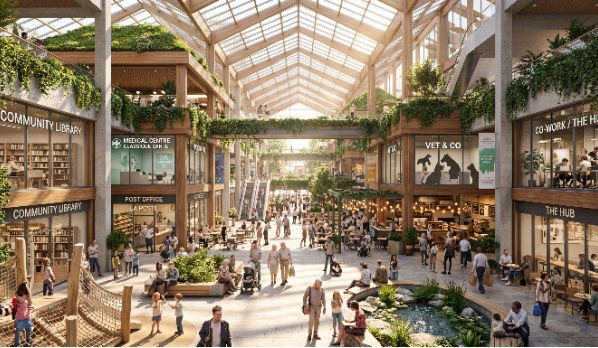
The strongest theme of the week was the one Europe Real Estate has argued for many years: the city metropolis. We reported a decade ago that the shopping centre would be fundamentally transformed, becoming a destination with the convenience of a small city, with health and wellness, offices, homes, education, leisure and food alongside the shops. MAPIC's programme now says the same, highlighting mixed-use schemes built around convenience, sustainability and community, while the wider debate spoke of retail space being repurposed for healthcare, co-working and entertainment. The winners showed what it looks like. Valvert Croix-Blanche Retail Park by Compagnie de Phalsbourg won Best New Development with 65,000m² built around a lake, 18 restaurants, padel courts and a climbing wall. At Stadshart Amstelveen, Unibail-Rodamco-Westfield combined 15 new brands with modernised workplaces, improved public spaces and stronger pedestrian links. NEXTOPIA by Siam Piwat turned 15,000m² at Siam Paragon into a "sustainable prototype city" that has drawn more than 4.2 million visitors. A place that serves daily needs is visited daily rather than occasionally, and its income no longer depends on retail sales alone.
Experience is the product
Experience and leisure sit at the heart of that mix. Activate plans around 30 active-gaming venues across France, Spain, Portugal and the Benelux, and COACH Play in Osaka increased time spent in store more than eightfold. The same logic runs through recent deals: Union Investment sold Les Grands Pres in Mons for €265m after 22 years of reinvestment and an IKEA addition, with tenant sales more than 30% above pre-COVID levels, and London is betting €176m on a traffic-free Oxford Street. Outlets keep expanding too, and VIA Outlets has grown its lettable area by 30% this year, although both of its shortlisted refurbishment projects lost out to NEXTOPIA's adaptive reuse.
Sustainability is now the licence to operate
Sustainability ran through almost every project that won recognition. NEXTOPIA embeds green building features, responsibly sourced materials and educational experiences throughout the customer journey, and was presented at the United Nations Global Compact Leaders Summit. Rembrandthof in Amstelveen incorporated ambitious sustainability measures, and VIA Outlets is the global leader for retail in the 2026 GRESB benchmark, having raised around €178m through a debut Swiss franc green bond last month. Reusing existing buildings also carries an embodied-carbon advantage. With energy costs high and volatile, efficiency is no longer only an ESG credential but a direct protection for net operating income, and it increasingly shapes access to green finance.
What we saw on the floor
The event itself has changed. MAPIC now runs for two days rather than four, and organisers expected around 4,000 to 4,400 participants and roughly 160 exhibiting companies, against around 8,500 professionals and more than 2,100 retail brands at earlier four-day editions. Visible spend on the floor was noticeably lighter: tighter budgets, more modest presence, less print and less corporate promotion than in previous years. That is a rational response to an uncertain year, and perhaps a healthy one, as the money that remained appeared to go into meetings rather than marketing. Retailers, meanwhile, were the most sought-after people in the building. With little new supply and international brands from Asia and the Americas such as Pop Mart, Wendy's and Dave's Hot Chicken arriving with expansion plans, occupiers have the pick of the sites. The scarce asset is no longer space but the right tenant.
The good and the bad
The outlook is encouraging but uneven. Outlets are having a strong year, with just under €1bn of centres sold in the first half, according to ecostra, and Savills reports footfall up 5.3% in Spain and 1.8% in Italy so far in 2026. The US is stabilising too: Coresight Research projects around 7,900 store closures this year against 5,500 openings, fewer closures than in previous years, though more stores are still closing than opening.
Not every market is moving in the same direction. Shopping centre values came under pressure in France and Germany in the first quarter, with yields (annual income as a percentage of price, which rise when prices fall) up by around 0.5 and 0.3 percentage points respectively, according to BNP Paribas Real Estate, although it was reported at MAPIC that Germany may now have bottomed out. Footfall in Poland has cooled from its peak, and Chinese consumers have become more cautious, which could slow demand from brands expanding abroad. For investors, the takeaway is selectivity: the recovery is real, but it favours the right markets and the right assets.
For investors and developers, the point that has received least attention is operating complexity. Running a small city is a different business from running a shopping centre: it needs health, office and residential operators, programming and energy management, all at a time when Europe is paying more for energy and unrest is pushing up security and insurance costs. Underwriting that focuses on rent and yield alone risks missing that cost. Owners who generate their own power, keep floorplates flexible and can curate a genuine mix of uses will have the advantage.
Get the latest commercial real estate news, investment insights, and property trends from Europe Real Estate, trusted by professionals since 1999.
Sign up for free weekly updates. Join here
People
- Simon French, Chief Economist, Panmure Liberum; opening keynote speaker at MAPIC 2026
- Alexandre Bompard, Chairman and Chief Executive Officer, Carrefour, and head of the French retail federation
- Philip Lane, Chief Economist, European Central Bank
Companies and organisations
- MAPIC, international retail property event in Cannes; organised by RX
- Panmure Liberum, investment bank and broker; employer of keynote speaker Simon French
- Savills, real estate adviser; research on cross-border retail park investment and European footfall
- CBRE, real estate adviser; H1 2026 European retail market summary
- BNP Paribas Real Estate, real estate adviser; Q1 2026 European retail investment data
- Carrefour, French retailer; reported damage to 50 stores in the October unrest
- Bruegel, European economic think tank; policy brief on Europe's AI compute shortfall
- Euronews, news organisation; reporting on AI sovereignty and Europe's dependence on China
- ecostra, outlet market research consultancy; outlet transaction data
- Coresight Research, retail research firm; US store openings and closures projections
- Compagnie de Phalsbourg, developer of Valvert Croix-Blanche Retail Park; MAPIC Award winner
- Siam Piwat, developer of NEXTOPIA at Siam Paragon; MAPIC Award winner
- Unibail-Rodamco-Westfield, developer of the Rembrandthof Extension at Stadshart Amstelveen; MAPIC Award winner
- Activate, active-gaming entertainment brand; MAPIC Award winner
- VIA Outlets, outlet owner-operator; MAPIC Awards finalist; GRESB global retail leader
- GRESB, global real estate sustainability benchmark
- Union Investment, investment manager; seller of Les Grands Pres, Mons