I want to talk about a specific kind of street.
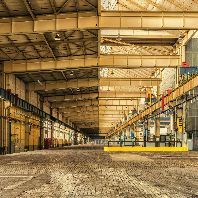
Not a food hall. Not a converted warehouse. Not a purpose-built market with an architect and a developer and a ten-year masterplan behind it.
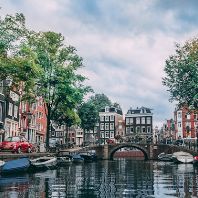
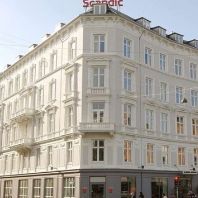
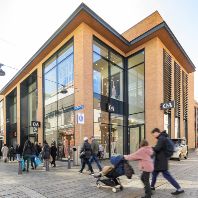
I want to talk about the ordinary European city street, the one with a florist, a hairdresser, a boutique, a small café, and three vacant units. The one that was interesting five years ago and is losing its character now, unit by unit, as the leases expire and the independents cannot renew on the same terms.
That street exists in every European city. And it is where the real conversation needs to happen.
The examples we keep celebrating, the Fenix Food Factory, the Markthalle Neun, the converted halls and regenerated quarters, are inspiring, but they are not the answer to the problem most city centres are actually facing. They require purpose-built infrastructure, developer capital, and years of planning. The street with three vacant units does not have any of that. It has existing buildings, existing landlords, and existing communities that want things to work.
The question is: what is the realistic model for that street?
What is actually breaking
Before we can talk about solutions, we need to be honest about the problem, and the problem has a specific shape.
In the UK, independent retailers accounted for over 84% of all store closures in 2024, a 45% surge on the year before. In the Netherlands, retail vacancy in the country's 40 largest city centres stood at 8.3% at the start of 2024, 2,500 empty units, many vacant for well over a year. Across Europe, the pattern is consistent: it is not the chains that are disappearing first. It is the independents. The ones with a story, a community, a reason for people to make a specific trip.
The three forces behind this are structural, not cyclical. Lease costs are priced for volume retailers. Permanently fragmented footfall that a single-function store cannot recover on its own. And average inner-city retail units that, at roughly 100 to 200 square metres, are neither large enough to absorb the cost structure of a multi-use concept nor small enough to be genuinely affordable for a solo creator or maker.
That unit size is worth dwelling on. The average deal size for a UK retail unit is around 190 square metres. On a prime European city centre street, that space costs between 200 and 800 euros per square metre per year, depending on the city. For a single independent operator, a designer, a ceramicist, or a small food producer, that is simply not viable. The model is structurally hostile to the very businesses that give a street its character.
Here is what I want to say directly to landlords and shopping centre owners who read this: lowering the rent is not a real solution, and I am not asking you to do it.
A building's valuation is calculated on the income it generates. Reduce rent, and you reduce yield. Reduce yield, and you reduce asset value. For anyone with lenders or investors attached to the property, this is not an abstraction; it is a balance sheet constraint. I understand this. The problem is that the current model, holding out for a chain tenant at full market rent while the unit sits empty for eighteen months, is not protecting that value either. An empty unit generates nothing. It suppresses the value of every unit around it. It signals to the street that something is wrong.
The alternative is not charity. It is a different commercial model entirely, one that shopping centres, in particular, are uniquely positioned to lead.
What a different model looks like
The most useful policy concept I have encountered for the problem of the ordinary street, not the grand regeneration project, but the street with vacant units and no master plan, is what urban planners call "meanwhile use."
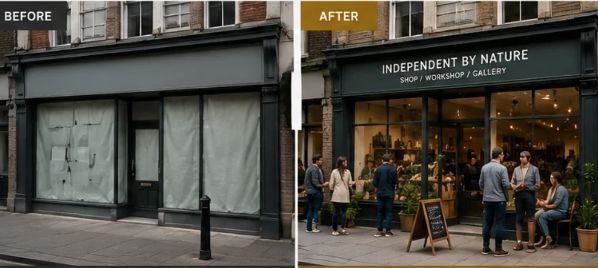
Meanwhile use simply means the activation of vacant space with temporary occupants while permanent solutions are developed or negotiated. Short-term licence agreements, low fit-out costs, and no long-term commitment from either party. The landlord keeps the asset active. The occupant gets to test and build without a five-year lease acting as a death sentence. The street stays alive.
What the research shows, consistently, is that meanwhile use does not just fill space temporarily. It builds the commercial case for permanence. A project in Enns, Upper Austria, deployed this model across a small town's main retail promenade. The results: customer traffic increased by 43%, five new businesses moved from temporary to permanent occupation, and there were no further closures. The model worked not because anyone built something new, but because someone created the conditions for affordable entry, short-term agreements, shared infrastructure, for the right businesses to test, prove themselves, and stay.
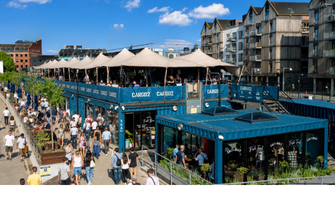
Savills, in a review of meanwhile use across their managed portfolio, noted that the transition from temporary to permanent is achievable when three conditions are met: the concept demonstrates community need, the financials work, and the landlord sees the long-term value of the tenant. Wapping Wharf in Bristol is a frequently cited example of temporary shipping container units that were so commercially successful they are now being replaced with permanent builds to house the same operators.
This is not a fringe model. It is a proven one. The problem is that it still depends entirely on individual landlords making individual decisions. No infrastructure makes it the default. And that is what needs to change.
Retail as a media channel
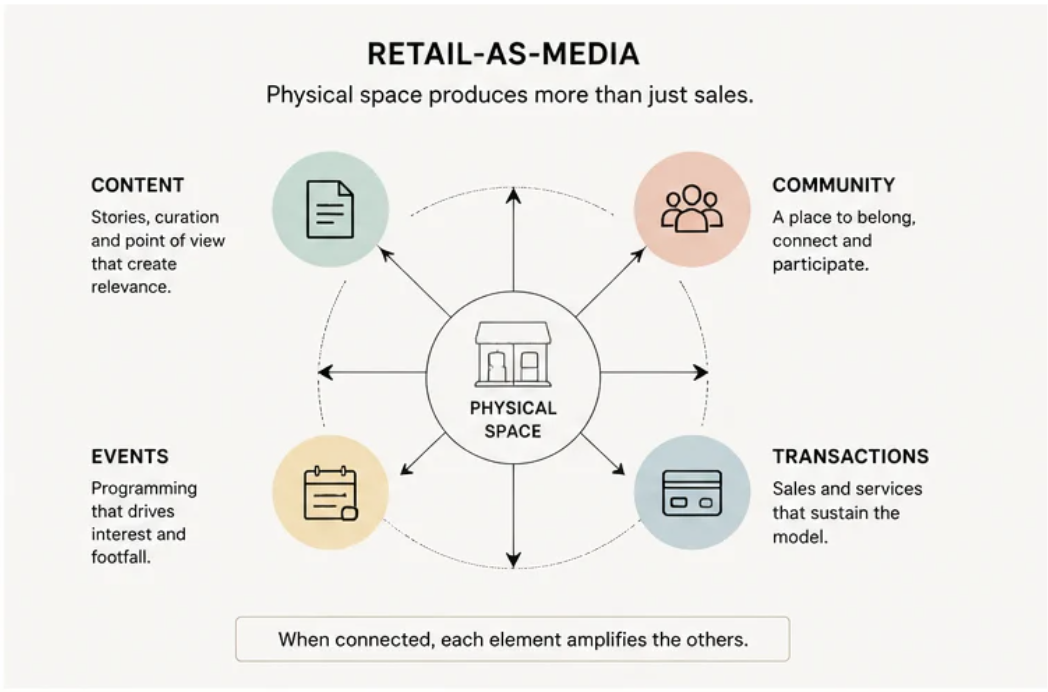
Here is the frame that changes everything: the most commercially interesting retail spaces are not stores. They are media channels.
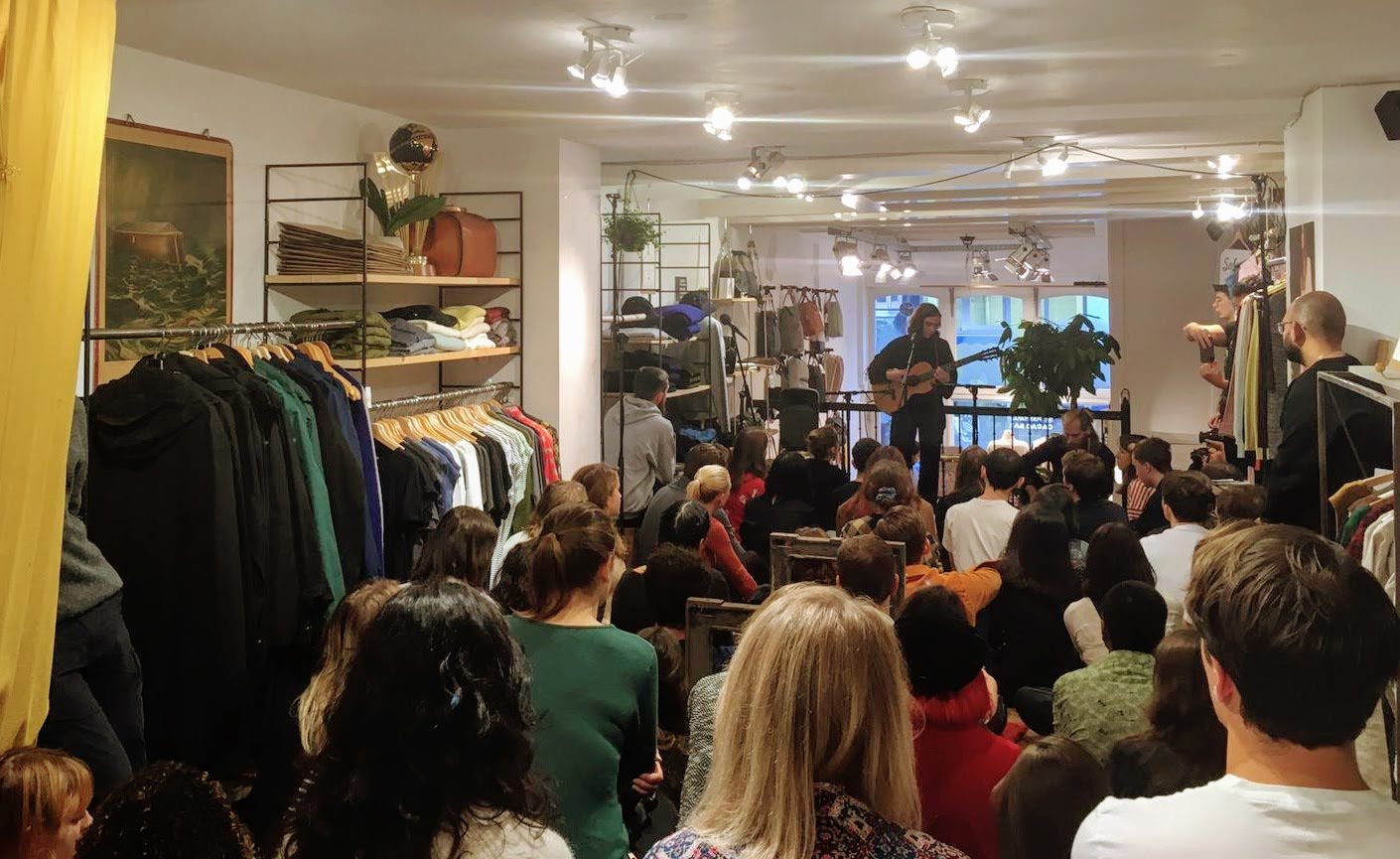
I built Six and Sons on this principle. A store, a cafe, a content studio, an events venue, a platform for independent makers, not because I wanted to run five businesses at once, but because I understood that footfall is content, community is audience, and a physical space that gives people a reason to return is worth more to a brand than any paid media placement.
The brands that understand this are not waiting for a landlord to lower the rent. They are asking a different question: what does this space produce beyond transactions? What content does it generate? What community does it anchor? What does it mean for a B2C brand, a digital-first retailer, or a platform business to have a physical address that people actually talk about?
Shopping centres that position themselves as media environments curating the tenant mix the way a publisher curates a masthead, programming events the way a broadcaster programmes a schedule, producing content that gives brands a reason to activate, are not just filling units. They are creating a proposition that no algorithm can replicate. They are the physical layer of an omnichannel story.
Digital retailers are finding this out at speed. The cost of customer acquisition online has made physical presence economically rational again, not as a store in the traditional sense, but as a content moment, a community anchor, a brand experience that earns media coverage and social amplification. Zalando, ASOS, About You, and Farfetch are all actively rethinking what physical presence means for a digital-native business. The shopping centre that understands it is in the business of selling that moment to the right tenant, at the right terms, as part of a curated programme, is the one that will attract the brands worth having.
This is not a theoretical position. It is a commercial strategy, and it is already working in the cities and centres that have started to build the connective tissue between landlords, operators, and the community.
The missing infrastructure
When I built Six and Sons, I approached the city for support. I explained what the space was: a cafe, a store, a content studio, an events venue, a platform for local makers. I explained the community it was building. I asked for the kind of structural backing that would let a concept like this survive its most vulnerable years.
What I found was that no designated body existed to receive that request. There was no infrastructure for it, no one whose job was to say: this is the kind of concept our city needs, here is how we help it grow, here is how we connect you with the right landlord, here is a meanwhile lease template, here is a small activation grant, here is a network of other operators building the same thing two streets over.
That gap is the real problem. And it is a policy failure, not a market failure.
The BID model (Business Improvement Districts), where local businesses collectively levy funds to invest in the area, is the closest existing structure to what is needed. In the UK, 300 BIDs are now investing over 131 million pounds annually into local economies, reporting footfall growth of 5 to 10% above comparable non-BID areas. The BID Foundation has documented many of these cases. Many BIDs now explicitly recognise that independent operators are what keep high streets vibrant and are directing funding toward supporting them. It is a meaningful model. But BIDs are funded by a levy on existing businesses, which means they are limited by the health of those businesses and they have no power over leasing, no direct relationship with landlords, and no mandate to curate what comes next.
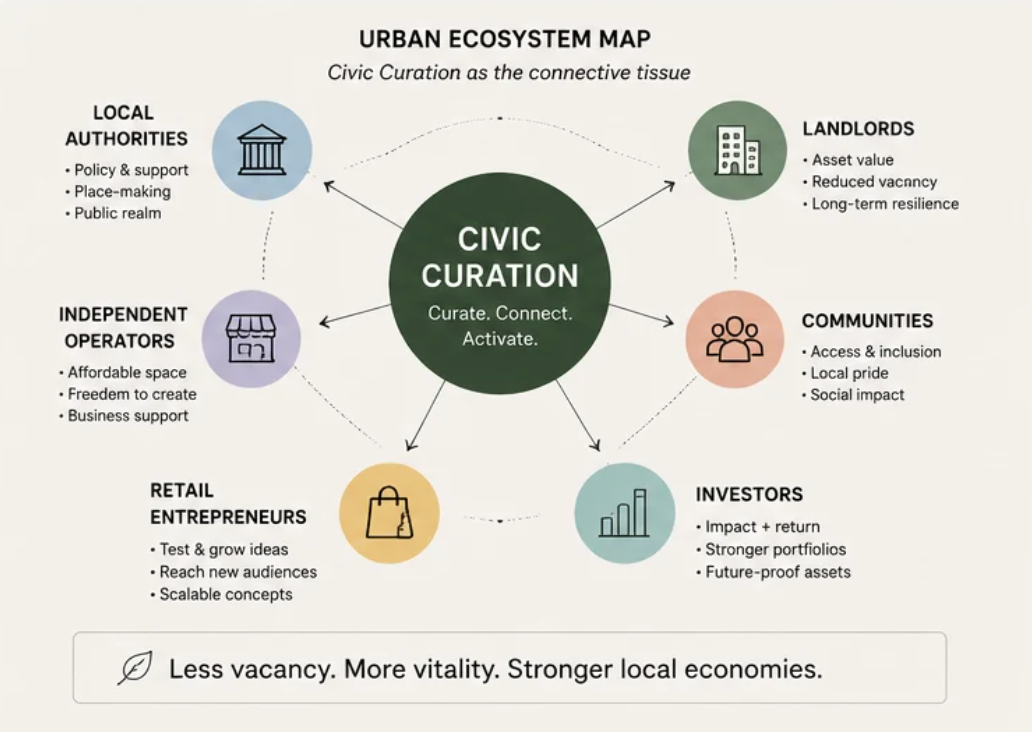
What is needed is something more structural. A civic curation function is a permanent body with a budget, mandate, and real relationships with both landlords and the independent operator community that sits inside the urban planning ecosystem and treats the health of the independent retail mix as a policy outcome, not an accidental byproduct of the market.
Not a grant committee. Not a temporary programme. A permanent function, with the ability to:
- Hold and offer meanwhile leases on behalf of willing landlords who lack the infrastructure to manage short-term activations themselves
- Curate and qualify independent operators, designers, makers, and local producers who are ready to occupy space but cannot absorb a standard lease
- Broker turnover-rent arrangements and revenue-share models, where base rent is set below market, but the landlord participates in the upside when the concept performs
- Connect operators to shared infrastructure, shared logistics, shared staffing, and shared digital presence that makes a 100-square-metre unit economically viable for a solo creator
- Commission the programming that turns a street into a destination: markets, events, workshops, content moments, community gatherings
This is not an expensive proposition. Many cities already have the skeleton of it across economic development agencies, BIDs, and planning departments. What is missing is the integration, the mandate, and the cultural will to treat independent retail as infrastructure rather than decoration.
The shared unit model
There is one more structural idea worth naming directly, because it addresses the unit size problem honestly.
A 100 to 200 square metre unit is too expensive for one independent operator. But it is not too expensive for three or four, operating as a collective.
The co-retailing model, multiple independent brands sharing one physical address, each with its own identity, together covering the operational costs, is already being tested in various forms. A ceramicist, a textile designer, a small publisher, and a local food producer, sharing a unit with a shared till, shared staffing on a rota, and shared programming budget. Each brings their own community. Together, they create a destination.
This is not hypothetical. It is already happening organically in cities across Europe, wherever commercial rents have become prohibitive for single operators. The question is whether landlords, city councils, and BIDs are willing to formalise and support this model, designing lease structures that accommodate collective tenancy, providing shared infrastructure, and treating the collective as a single anchor rather than four separate credit risks.
A street of four such units, each housing a rotating collective of three or four local makers, is not a food hall or a regenerated warehouse. It is just a street. But it is a street with sixteen independent operators, a dozen community events per month, and a reason for people to come back every week.
For shopping centres, the proposition is even clearer. A co-retail unit does not just fill a vacant bay. It generates content, community, and repeat visits. It gives a centre a story to tell. It creates the kind of tenant mix that no directory of chains can produce.
Who is starting to get this right
The most interesting models I see across Europe are not the big developments. They are the programmatic ones, cities and organisations that have started to build the connective tissue between landlords, operators, and community without waiting for a developer to write a cheque.
Meanwhile, in Oxfordshire, a pilot programme funded by the local enterprise partnership and run by Makespace Oxford, transformed vacant retail units across multiple towns into independent shops, cultural venues, creative studios, and co-working spaces using short-term licence agreements and capital grants to lower entry barriers. It was not a market hall. It was an existing street, existing units, existing landlords, with a new operating layer placed on top of them.
In Enns, Austria, the Zeitgeist pop-up concept operating under the European Union's LEADER rural development programme turned a street with chronic vacancy into one of the region's most active retail promenades, using flexible rental models and micro-event programming to attract new operators and retain them permanently.
In both cases, the intervention was not physical. It was organisational. Someone built the infrastructure that the market was not providing.
That is the model that scales. Not the food hall. The function.
What needs to happen now
The cities and shopping centres that will win the next decade, whether that is Unibail-Rodamco-Westfield, Hammerson, Klepierre, or British Land, are not the ones that build the best new market. They are the ones that protect and cultivate what they already have, that treat the independent operator not as a credit risk to be managed but as civic infrastructure to be invested in, and as media inventory to be programmed.
For that to happen, three things need to change simultaneously:
Lease structures need to evolve. Meanwhile licences, turnover rents, collective tenancy arrangements, and shorter initial terms with renewal options for proven performers should be the norm, not the exception. England and Wales have now legislated against upward-only rent reviews. The rest of Europe should follow and go further.
A civic curation function needs to exist in every major European city. Not a programme. Not a committee. A permanent function with budget, relationships, and a mandate to curate the independent retail mix the way a city curates its parks and its schools as essential public infrastructure.
Shared infrastructure needs to be built into the ecosystem. Shared logistics, shared digital platforms, shared staffing models, shared events budgets. The economics of the 100-square-metre unit only work if operators are not each carrying the full overhead alone.
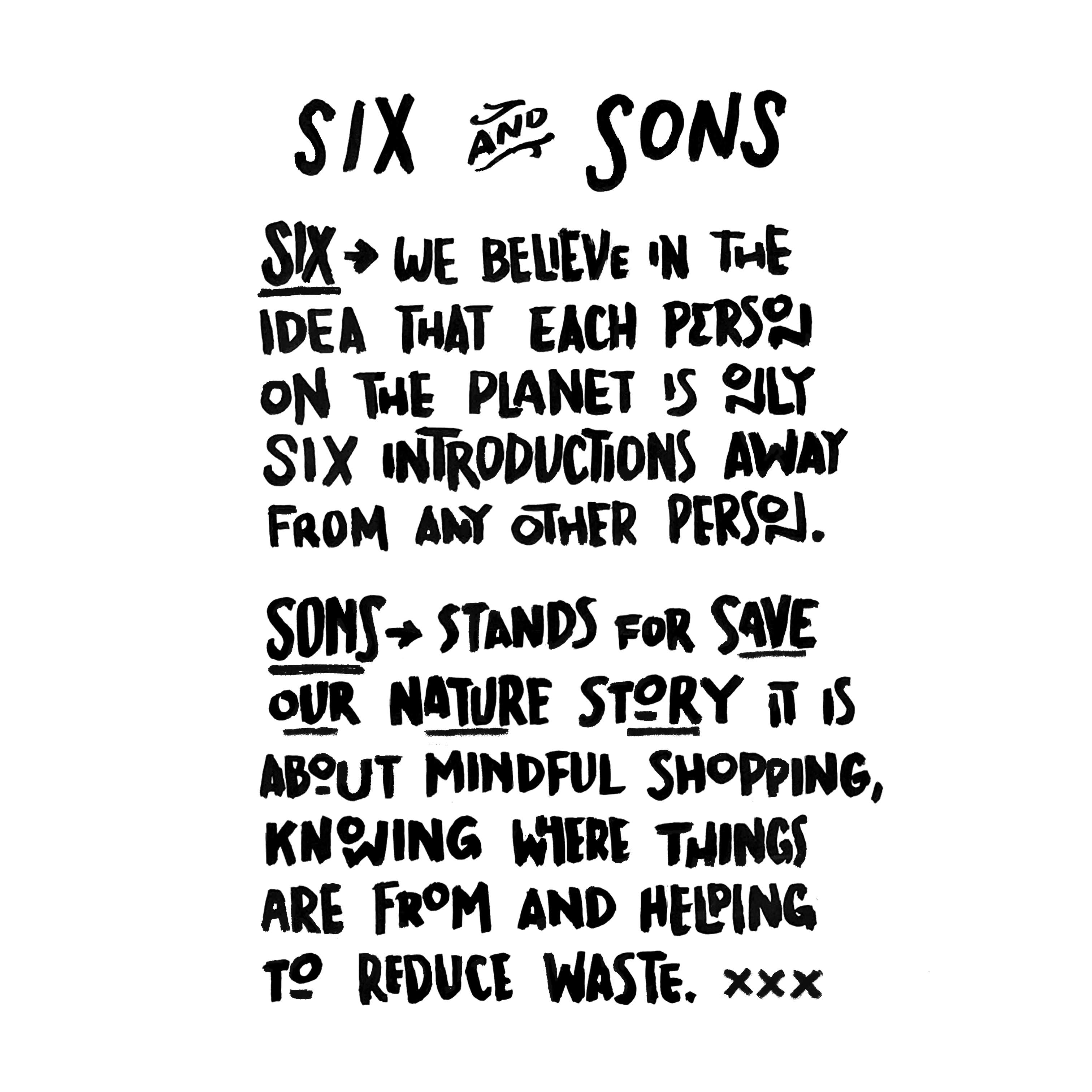
The community came first. Commerce followed. I learned that building Six and Sons, and I have seen it confirmed in every city I have worked in since.
The question is not whether this model works. It does.
The question is who has the ambition to build it and who gets left behind because they waited for someone else to go first.

About the author
Ilona Klevansky Taillade is General Manager at Fashot B.V. and founder of Six and Sons. She is a retail strategist and live commerce advisor with direct experience across independent retail, digital content production, phygital brand activation, and European real estate. She works with retailers, shopping centre owners, landlords, and city authorities across Europe on the commercial and operational models that make independent retail viable in a digital-first world. She is currently developing a mobile-first live commerce platform concept bridging physical and digital retail, and is a founding voice in the debate about retail as media infrastructure. Connect on LinkedIn.