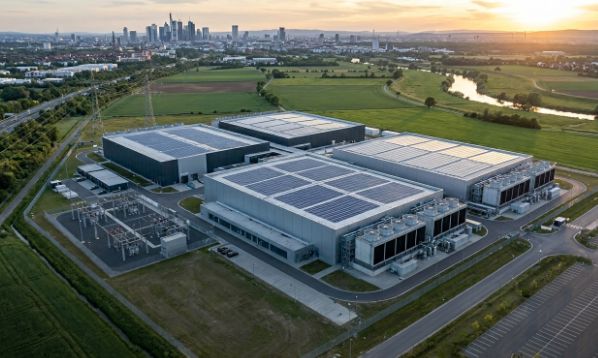
The European commercial real estate market is undergoing its most significant structural shift in a decade. While traditional sectors navigate the complexities of post-pandemic recovery and elevated interest rate environments, one asset class has emerged as the undisputed destination for institutional capital: data centres. Artificial intelligence is no longer a speculative technology. It has become the primary demand driver for European data centre capacity, and the implications for the wider property market are profound.
The computational requirements of generative AI, machine learning applications and accelerating cloud migration have created a supply-demand imbalance that developers are struggling to address. CBRE forecasts that vacancy rates across Frankfurt, London, Amsterdam, Paris and Dublin, collectively known as FLAP-D, will compress to historic lows by the end of 2026, even as record-breaking new supply enters the market. The challenge for operators is no longer sourcing tenants. It is securing adequate power and land to meet exponential demand.
"The combination of escalating demand, increasing but constrained supply, and grid limitations is expected to fuel continued upwards pressure on pricing and the need for innovative solutions." CBRE, European Real Estate Market Outlook 2026
Access to electricity has become the single most critical variable in site selection. European grid constraints have lengthened connection timelines from months to years, forcing operators to explore on-site generation as a long-term deployment strategy rather than a transitional measure. Despite higher costs and complex reporting requirements compared to grid power, the approach is gaining traction as tenant acceptance grows. The competition for power extends well beyond data centres. Logistics developers, industrial occupiers and residential projects are all vying for limited grid capacity, creating cross-sector tension that will define European real estate development for the remainder of the decade.
Institutional investors are responding to these fundamentals with substantial capital allocation. PGIM Real Estate identifies data centres as a core structural investment theme, noting that supply shortfalls point to strong rental growth across FLAP-D markets, with Dublin and Amsterdam best positioned to benefit from the demand-supply imbalance. The tenant pool is also diversifying. GPU-as-a-Service providers and AI infrastructure companies are now actively seeking double-digit megawatt capacity across the continent, introducing new covenant considerations alongside more established hyperscale demand.
Despite the strength of demand, speculative development remains limited. Most operators are unwilling to commit the significant capital expenditure required without pre-let agreements in place, making partial pre-lets increasingly commonplace across major markets. This dynamic is compressing available supply further and reinforcing upward rental pressure in core locations.
The data centre boom is generating significant ripple effects across adjacent sectors. In logistics, industrial and data centre developers are increasingly competing for the same prime land and contractor services, driving up development costs and extending timelines across both asset classes. In office markets, AI companies are emerging as a notable source of demand in gateway cities, with landlords focusing attention on tech talent hubs and jurisdictions offering favourable regulatory conditions for AI development. Meanwhile, the energy demands of digital infrastructure are accelerating the integration of renewable systems into real estate assets. Brookfield Asset Management's £1 billion investment in UK solar energy reflects a broader strategic realignment as real estate players seek to address energy challenges and ensure long-term operational resilience.
Regulatory scrutiny is intensifying alongside the sector's growth. The revised Energy Performance of Buildings Directive introduces phased minimum energy performance standards targeting the worst-performing 16% of existing buildings by 2030, rising to 26% by 2033. For data centre operators, the ability to demonstrate credible climate commitments through robust transition plans is no longer purely a compliance matter. Decarbonisation and climate risk management are becoming central priorities for investors and lenders alike.
Looking ahead, the structural drivers underpinning European data centre demand, AI adoption, cloud migration and the digitalisation of economies show no signs of abating. For institutional investors, the opportunity lies in partnerships between operators and lenders with sector track records, or complementary expertise in power infrastructure. These collaborations unlock favourable financing terms and cross-industry synergies that are proving essential for delivering large-scale projects in a constrained environment.
"We are operating in an environment where we regard volatility as a feature, not a bug. That means trying to see through cycles and take positions that we feel offer growth and duration." Investment Head, Global Real Estate Fund
For a market seeking to redefine its value proposition in an era of higher rates and geopolitical uncertainty, data centres offer something increasingly rare: exposure to secular technological trends with the long-term, capital-intensive commitment that has historically defined core real estate. That combination is proving irresistible.
Sources CBRE, European Real Estate Market Outlook 2026 PGIM Real Estate,
European Real Estate Outlook 2026 Brookfield Asset Management, UK solar energy investment programme