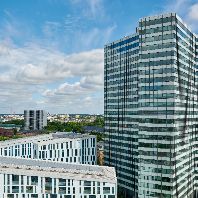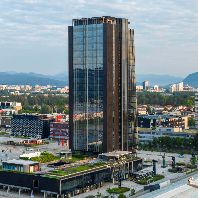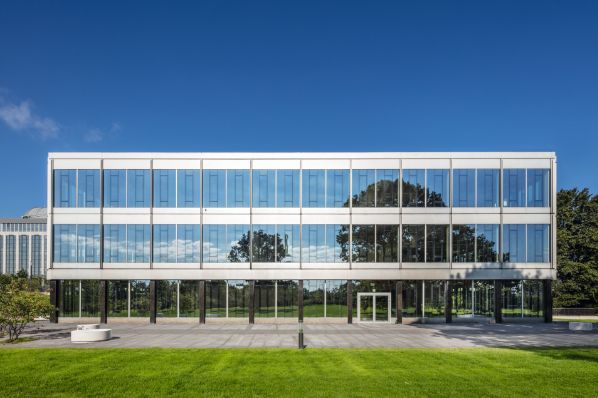
Union Investment has pulled off a piece of asset management most Dusseldorf landlords can only envy this year: full occupancy. The investment manager has signed a 10-year lease with a global technology group for 9,666 m² of office space, 179 m² of storage and 140 parking spaces at "Seestern 3", its architectural landmark on the left bank of the Rhine. The lease runs from the second quarter of 2027, and with it, the roughly 33,000 m² tower stays fully let even as its long-standing anchor tenant prepares to scale back.
The address does much of the selling itself. Seestern has established itself as an international hub for media and communications technology, with strong transport links, a cluster of hotels and a roster of corporate headquarters that make it one of Dusseldorf's more resilient office locations, exactly the kind of setting that continues to draw large occupiers even as demand elsewhere in the city cools.
The timing is no accident. Sven Lintl, Head of Asset Management DACH at Union Investment, explained the logic behind the deal:
"Our proactive and forward-looking asset management approach is paying off: We were able to secure a new tenant early on for a portion of the space currently occupied by our main tenant, Deutsche Telekom, in 'Seestern 3.' This allows Deutsche Telekom to optimise its total space and return the relevant areas in a timely manner for the necessary renovation work. The company is expected to move out of 'Seestern 3' in the third quarter of 2027. We are already in discussions with various interested parties regarding additional space." In other words, Deutsche Telekom is not leaving so much as making room, and Union Investment had a replacement lined up before the gap ever opened.
There is history behind the glass. The five-storey building, part of the UniImmo: Europa portfolio since 1999, was designed in 1961 by Helmut Rhode, the Dusseldorf architect who built it as headquarters for the Horten department store group and, in doing so, created the first building in Germany conceived exclusively as open-plan office space. The firm Rhode founded a decade earlier, RKW Architektur, has now come full circle: it handled the tenant fit-out planning for the very building its founder once designed.
For investors and developers watching the wider market, the deal doubles as a useful data point. Citywide vacancy in Dusseldorf has been climbing all year, reaching 11.8% by the middle of 2026, yet prime rents held their ground at €46.00 per m² per month over the same period. Cushman & Wakefield's own research points to why: landlords offering modern, well-located, sustainability-certified space are seeing demand hold up, while older stock in less central locations is absorbing most of the vacancy. Seestern 3's LEED Gold certification, the product of a 2013 to 2015 modernisation that added a private park, two inner courtyards, a three-storey pavilion and a park-facing terrace, is precisely the kind of capital expenditure this bifurcated market is rewarding. The building, together with its park, also holds protected historic landmark status.
People mentioned:
- Sven Lintl – Head of Asset Management DACH, Union Investment
- Helmut Rhode – Architect who designed Seestern 3 in 1961 and founded RKW Architektur
Image Source: Union Investment
Companies mentioned:
- Union Investment – Investment manager and owner of Seestern 3
- UniImmo: Europa – Open-ended real estate fund holding the property
- Deutsche Telekom – Outgoing anchor tenant at Seestern 3
- Cushman & Wakefield – Transaction broker
- RKW Architektur – Tenant fit-out planning