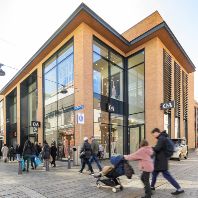
Retail property has firmly re-established itself as Europe's most compelling real estate investment sector, delivering the strongest total returns across all traditional property classes in 2025 and positioned to achieve approximately 9.5% returns in 2026. This performance marks a definitive end to years of structural disruption, as online penetration plateaus at 28% and retailers pivot back towards physical space investment, creating a symbiotic relationship between digital and bricks-and-mortar channels.
Knight Frank research reveals retail delivered 9.2% total returns through Q3 2025, outperforming industrial (9.1%), offices (3.2%) and all property (6.6%). Shopping centres and foodstores led with 10.2% returns each, whilst income returns of approximately 5.7% continue surpassing the all property average. Total retail investment volumes are forecast to reach €6.8bn (£5.83bn) in 2025, with any shortfall from the 10-year average attributed to limited stock availability rather than weakening demand, a critical signal for developers eyeing opportunistic development plays in undersupplied markets.
National retail vacancy dropped to 13.5% in Q3 2025, the lowest since 2020, with retail warehousing achieving sector-leading vacancy rates of approximately 5%. This compression, combined with sustained rental growth, has created one of the strongest occupational environments in over a decade. The marked slowdown in large-scale occupier distress further validates the sector's stabilisation, whilst limited development pipeline in retail warehousing presents compelling opportunities for developers willing to deliver modern, efficiently designed schemes in strategic locations.
Transaction momentum accelerated sharply in H2 2025, with shopping centres recording over €1.17bn (£1bn) traded and prime yields tightening 25 basis points to 7.25% NIY. High street retail saw €491m (£420m) transacted in H2, a 150% increase on H1, with competitive bidding re-emerging in prime centres and regional cities. Foodstores have become one of the most sought-after asset classes, driven by renewed sale-and-leaseback activity, though constrained by limited openly marketed stock.
"Retail has decisively turned a corner with 2025 marking the high street's rebound. Occupational markets are the strongest they've been in over a decade and pricing has rebased, which is clearly reflected in retail's total return performance. Retail's high income return and improving rental dynamics continue to attract capital, with an increasing number of investors deploying where cashflows are durable and risk is appropriately priced," said Sam Waterworth, Partner, High Street, Capital Markets at Knight Frank.
"With online penetration flatlining and retailers reinvesting in physical space, the narrative around retail has fundamentally changed. Shopping Centres and Foodstores are now leading performance across all real estate, while Retail Warehousing remains the occupational darling. Across the board, retail is a holistically investable sector. We have great confidence that this demand is going to drive a return to decade-high investment volumes in 2026, and we are expecting a busy year across all of the subsectors," added Will Lund, Partner, Head of Retail, Capital Markets at Knight Frank.
People mentioned:
- Sam Waterworth, Partner, High Street, Capital Markets, Knight Frank
- Will Lund, Partner, Head of Retail, Capital Markets, Knight Frank
Companies mentioned:
- Knight Frank, Real estate consultancy and research
Image: AI-generated for illustrative purposes only