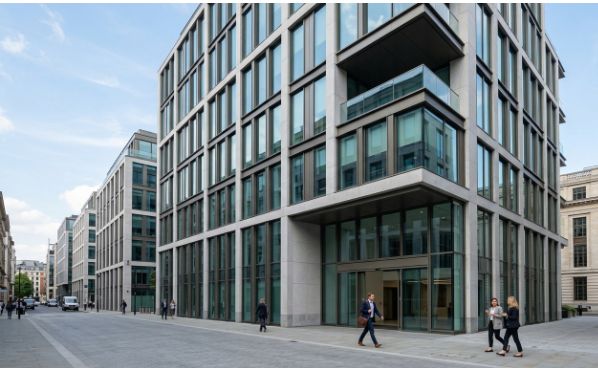
European commercial real estate has quietly done something remarkable: it has grown in value for seven consecutive quarters, even as higher yields, geopolitical turbulence and a stubborn office correction have weighed on sentiment. New data from Altus Group confirms the recovery is real, income-driven, and broadening, though the picture for investors and developers is far from uniform.
Altus Group's Q1 2026 Pan-European valuation dataset, tracking open-ended diversified funds representing approximately €30bn in assets across 16 countries, recorded a 0.7% rise in commercial property values, up from 0.4% in the prior quarter. The gains were driven almost entirely by cash flow, with rental income contributing 1.0% to overall performance, partially offset by a second consecutive quarter of outward yield movement, which trimmed returns by 0.1%. Over one year, values are up 1.7%, though the market still carries the weight of the 2022-2024 correction, with values down 1.6% per annum over three years and 0.9% over five.
"The quarter's gains underscore a recovery that remains cashflow-led, with improving contract and market rents doing most of the heavy lifting," said Phil Tily, Senior Vice President at Altus Group. "At the same time, modest outward yield movement is a reflection of ongoing market caution as investors and valuers navigate a complex macro and geopolitical backdrop."
The standout performer was student accommodation, which recorded a 2.5% quarterly gain, driven by a 2.1% rise in market rents and year-on-year rental growth of 10.5%, confirming purpose-built student housing as one of Europe's most resilient and fundamentals-backed asset classes. Residential followed with a 1.2% increase, supported by acute supply shortages across Germany, the Netherlands and Spain, where private rents are forecast to rise by up to 5.3% in 2026. Industrial and logistics advanced 0.7%, benefiting from steady occupier demand and near-zero yield drag. Retail returned 0.7%, with retail parks and warehouse-style formats outperforming, as prime locations increasingly attract institutional capital after years of repricing. Offices, however, rose just 0.2%, as a 0.5% drag from rising capital expenditure requirements, largely for energy retrofitting and ESG compliance, offset by improving prime rents in select central business districts. For developers and asset managers, this signals a critical window: buildings that fail to meet modern sustainability standards are facing accelerating obsolescence, with the cost of inaction growing quarter by quarter.
What the headline figures do not fully capture is the growing bifurcation within each sector: prime, ESG-compliant assets are attracting capital compression and strong rental growth, while secondary stock continues to reprice downward. Investors who can identify, reposition and decarbonise assets ahead of incoming EU taxonomy thresholds stand to capture both yield compression and rental upside, a dual return opportunity that is becoming increasingly rare across global real estate markets.
People and companies mentioned
- Phil Tily, Senior Vice President, Altus Group (pan-European real estate valuation and data analytics firm)
- Altus Group: provider of the Q1 2026 Pan-European valuation dataset, tracking approximately €30bn in open-ended diversified fund assets across 16 European countries