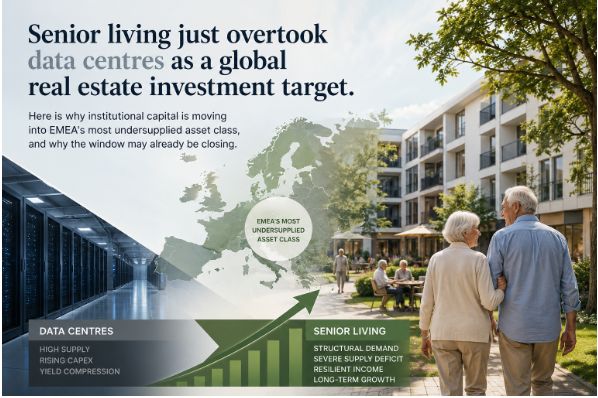
Institutional capital is flowing into senior living at a pace not seen before, with the asset class more than doubling its share of EMEA real estate investment in just a few years, and now outpacing data centres globally.
Senior living accounted for 11% of total EMEA real estate investment in Q1 2026, up from just 4% in recent years, according to new data from Colliers. The shift represents one of the most significant sectoral reweightings in the European investment market in recent memory, driven by mounting institutional conviction in assets where income is tied directly to demographic need rather than cyclical demand.
"Alongside core sectors such as office and industrial, investor conviction is building in more specialised, operational asset classes such as senior living."Damian Harrington, Head of Research, Global Capital Markets & EMEA, Colliers
The asset class has also cemented its position on the global stage, with senior living investment volumes surpassing those of data centres in early 2026, a milestone that underscores how far the sector has travelled from its niche origins. For investors, the appeal is structural: Europe's over-65 population is forecast to grow by more than 40 million by 2050, yet the supply of purpose-built senior housing across EMEA remains critically undersupplied, creating a fundamental mismatch that developers and operators are only beginning to address at scale.
"Global capital markets are becoming increasingly fragmented, and investors are responding by directing capital towards markets that offer scale, liquidity and pricing clarity."Luke Dawson, Head of Global and EMEA Capital Markets, Colliers
That fragmentation is reshaping deployment strategy. While investment continues to concentrate in larger, more liquid EMEA markets such as the UK, Germany and the Netherlands, the broadening of sector allocation opens a significant opportunity for developers who can deliver institutional-grade senior living product, particularly in markets where the regulatory framework and planning consents for care and assisted-living schemes have traditionally lagged residential. One area that remains underreported is the acute shortage of mixed-tenure senior living communities, where market-sale, affordable, and care accommodation sit on a single site, a model well-established in the United States and Australia that is only now attracting serious developer attention in Europe.
The broader reweighting towards operational real estate reflects a deliberate shift away from pure capital-growth strategies, as investors seek assets where income performance is anchored in occupancy and care fees rather than lease expiries alone. For those with the operational expertise, or the appetite to partner with it, the window to establish scale positions in EMEA senior living at still-rational pricing may be narrowing.
People mentioned
- Damian Harrington
Head of Research, Global Capital Markets & EMEA, Colliers - Luke Dawson
Head of Global and EMEA Capital Markets, Colliers
Companies mentioned
- Colliers
Global real estate services and investment management firm; source of Q1 2026 EMEA capital flows data