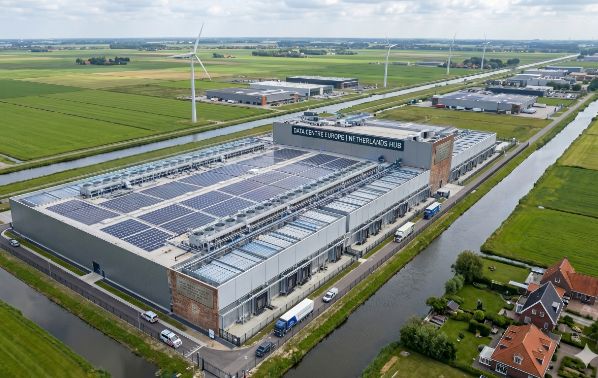
Research from Savills reveals a largely overlooked ripple effect: every megawatt of new data centre capacity is pulling warehouse occupiers into its orbit, and the numbers are only heading one way.
Europe's accelerating data centre pipeline is quietly reshaping the logistics market. New analysis by Savills estimates that 786,130 m² of additional warehouse space will be absorbed over the next three years, driven entirely by occupiers servicing the data centre supply chain, from spare parts storage to power infrastructure. The figure is extrapolated from live construction activity across the five dominant European data centre markets, Frankfurt, London, Amsterdam, Paris and Dublin (FLAPD), where 950 megawatts (MW) of capacity is currently under construction.
The research draws on two reference markets where the trend is already measurable. In Dublin, data centre supply chain occupiers accounted for 10% of annual logistics take-up in 2025, totalling 20,900 m², with a further 46,450 m² under offer from tenants in the same sector. In Houston, three of the top five deals in Q4 2025 were driven by occupiers servicing data centre or energy grid demand, representing 11% of H2 2025 take-up, a near-identical share. From this, Savills calculated a logistics absorption rate of 674 to 981 m² per MW of data centre capacity under construction.
"Much of the commentary around the growth of the DC market is focussed on land sales and power yet very little has been written about the ripple effect into the logistics market. Whilst our analysis is at an early stage it is interesting to observe that in markets which have seen exceptional growth in DCs we are now seeing the suppliers to the DC community take traditional logistics warehouses. Taking an average of 827 m² of logistics space per MW and extrapolating demand for the dominant European DC markets, Frankfurt, London, Amsterdam, Paris and Dublin (FLAPD), where 950 MW of space is currently under construction, we would estimate an additional 786,130 m² of demand for logistics space. While this trend is in its early stages in Europe, we're already seeing evidence of this in the UK, with DC power solutions and AI infrastructure firm AVK SEG leasing 13,000 m² of logistics space in the North West of the UK."
Kevin Mofid, Head of EMEA Logistics Research, Savills
For investors and developers, the timing demands attention. European development pipelines are contracting precisely as this new demand category emerges. Vacancy rates remain relatively elevated for now, providing a short window in which occupiers can still secure well-located, mission-critical warehouse facilities. Critically, data centre supply chain requirements tend to cluster tightly around established DC campuses, creating a geographically concentrated, highly predictable demand signal, the kind that supports asset pricing and long-term leasing strategies. Investors with logistics holdings near major FLAPD campus zones are likely to find themselves with a structural occupier advantage that was not priced in 18 months ago.
"Across Europe, we are starting to see 3PL occupiers and specialist contractors start to take space to service the DC community. In the first instance it is no surprise such requirements are in the more advanced DC markets of Ireland, the UK and The Netherlands. However, as DCs continue to proliferate across Europe we expect this trend to emerge elsewhere. Whilst occupiers are currently benefitting from generally higher vacancy rates across Europe development pipelines are trending downwards and as time progresses it may become more challenging to procure these mission critical warehouse facilities."
Sam Quellyn Roberts, Director, Global Occupier Services / EMEA Logistics Markets, Savills
Across Europe, live data centres currently account for 10,990 MW of capacity, with a further 2,449 MW under construction. If the FLAPD pipeline delivers as projected, and the DC-to-logistics absorption ratio holds at the rates observed in Dublin and Houston, the sector is on course to become one of the most consistent new demand drivers in European logistics, distinct from traditional e-commerce and retail cycles, and largely insulated from consumer sentiment shifts. For developers assessing speculative pipeline decisions near Frankfurt's Ostend corridor, Amsterdam's data centre ring, or London's key fibre hubs, the case for proximity-driven logistics stock is becoming increasingly quantifiable.
People mentioned
- Kevin Mofid, Head of EMEA Logistics Research, Savills
- Sam Quellyn Roberts, Director, Global Occupier Services / EMEA Logistics Markets, Savills
Companies mentioned