By Eleni Stefania Kalapoda
Key Takeaways
Reuse is moving from heritage gesture to disciplined investment strategy as regulation, occupier demand and digital tools converge. Retained structures save time, cost and embodied carbon, layered uses spread income risk, and landmark buildings can anchor entire districts. AI-assisted surveys and design testing now narrow the uncertainty that once made reuse a gamble, provided experienced professionals verify the results.
New York, United States: For much of the last century, the default answer to an underperforming building was demolition: clear the site, start again, and let the new asset justify itself. That logic is losing its grip across Europe, and not for sentimental reasons. Investors, developers and owners are discovering that an existing building, approached with rigour, can be the faster, lower-risk and more resilient route to new space.
Three forces are converging. Regulation is beginning to price what demolition throws away: the recast Energy Performance of Buildings Directive will require whole-life carbon to be calculated for large new buildings from 2028, and London already asks major schemes to assess whole-life carbon and circular-economy performance at planning stage. Occupiers increasingly seek space with character and a credible sustainability story. And a new generation of digital tools is removing much of the uncertainty that once made reuse a gamble.
Europe's finest projects show what that convergence is worth.
Building on what is already there
Kraanspoor in Amsterdam is a masterclass in seeing value where others see a constraint. A 1950s concrete crane track, left behind on the NDSM wharf, became the base for a lightweight, fully glazed office building raised above it. Rather than investing in new foundations on a demanding waterfront site, the scheme borrowed structural capacity that already existed and added lettable floor area on top. The lesson for owners is simple: before commissioning a new structure, establish precisely what the existing one can carry.
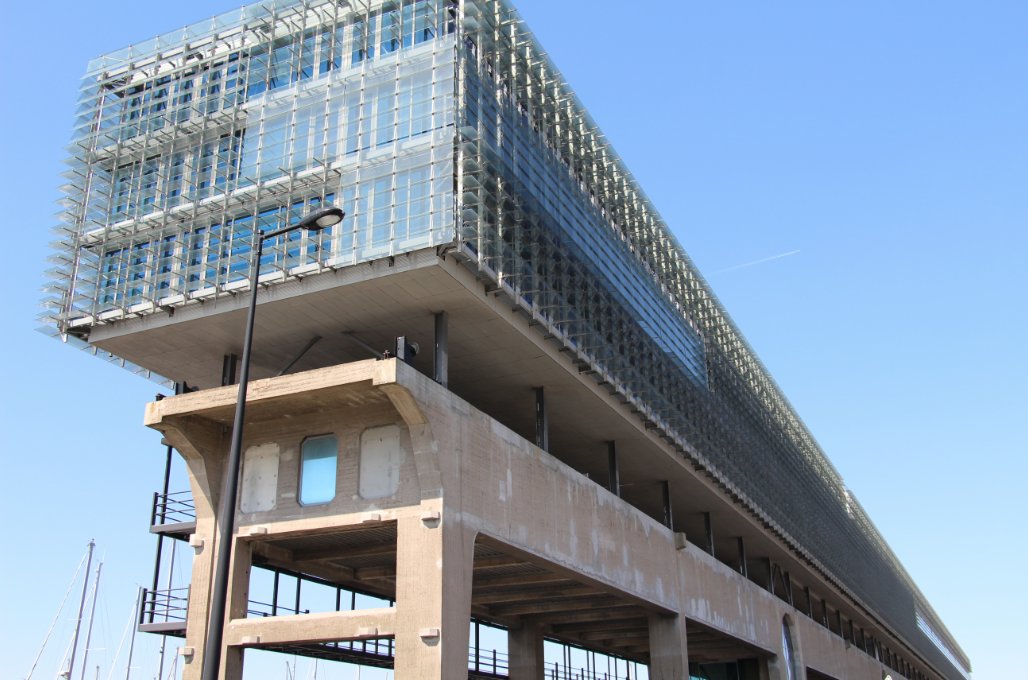
Image source: Wikimedia Commons, photo by Fred Romero, CC BY 2.0
Programming that keeps an asset earning
De Hallen, a former tram depot in Amsterdam's Oud-West, demonstrates the commercial power of layered use. The restored halls now bring together a food hall, a cinema, a hotel, shops and workspace under one roof. Each use draws a different audience at a different hour, so footfall is spread across the day and the week rather than concentrated in a single trading peak. For an investor, that diversity is a form of risk management: no single tenant or sector carries the asset alone.
The landmark as a district anchor
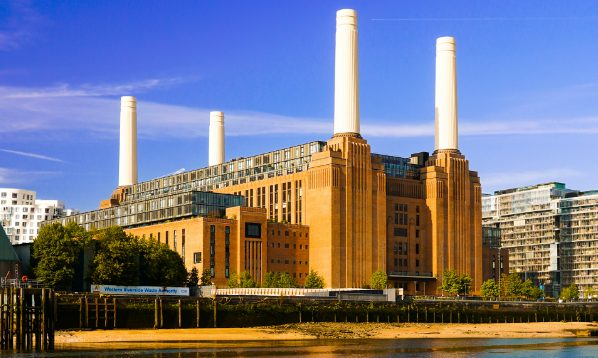
Battersea Power Station shows reuse at its most ambitious. A listed landmark that stood empty for decades has become the heart of a new London district, with homes, shops, leisure and offices organised around it, and a major technology company choosing the restored building for its London campus. Few owners will take on a project of that scale, but the principle travels: a building with genuine identity can anchor value well beyond its own walls and lift an entire masterplan.
What juries, and increasingly capital, now reward
The 2026 RIBA Stirling Prize was conferred on Lion Green Road in Croydon, council-led homes built on a former car park. Having served as sustainability expert on the RIBA Awards jury that assessed it, I have been struck by how far the conversation has moved: the questions are increasingly about how intelligently a project uses its site, what it retains and how it will perform over decades, rather than about spectacle. Shifts in what the profession celebrates have a habit of preceding shifts in what capital prices.
Where digital tools change the arithmetic
Reuse has always carried one stubborn risk: you do not fully know what you have bought until you open the walls. This is where digital tools are rewriting the arithmetic.
Laser scanning and photogrammetry can now capture an existing building as a dense, measured point cloud within days. AI-assisted processing can classify that data into walls, slabs, columns, and services, producing a working model far faster than a manual survey. On that model, design teams can test dozens of options, from structural loads and floor-to-floor heights to daylight, layouts and lettable area, before an acquisition closes rather than after.
In my own design work, computational tools have proved most valuable precisely here: generating and testing options quickly wherever results can be verified, so that expert judgment is reserved for the decisions that matter. For an investor, the effect is a narrower band of uncertainty at the point of acquisition, fewer surprises on site and a more defensible business plan.
The caveat matters. These tools accelerate analysis; they do not replace expert review. A scan cannot reveal every concealed defect, and an algorithm carries no professional responsibility. The strongest teams pair digital speed with rigorous verification by experienced engineers and architects.
Five lessons for developers, investors and owners
- Start with an inventory, not a demolition plan. A precise digital survey of structure, condition and capacity should precede any decision to clear a site.
- Treat the structure as capital. Retained frames and foundations carry value, programme time and embodied carbon that new construction must otherwise pay for.
- Diversify the programme. Uses that trade at different hours spread income risk and keep the asset alive.
- Price regulation forward. Whole-life carbon reporting is moving from best practice to obligation; assets prepared for it today will be easier to finance, let and sell tomorrow.
- Let AI narrow the uncertainty, and let professionals sign it off.
Europe's head start
Europe enters this era with a genuine advantage: dense historic cities, a mature heritage culture and regulators willing to set a clear direction. Its most successful projects show that reuse is not a compromise between value and conscience. Done well, it is simply sound investment: faster to market, more resilient and aligned with where occupiers, lenders and regulators are already heading.
Increasingly, the second life of a building is where its finest returns are found.
Eleni Stefania Kalapoda is a New York-based architect and urban designer. She began her professional experience through collaborations with the Renzo Piano Building Workshop team on the Stavros Niarchos Foundation Cultural Center, and later worked at Foster + Partners (King Salman International Airport) and Perkins Eastman on projects at the building and city scale. She served as sustainability expert on the RIBA Awards jury that assessed Lion Green Road, winner of the 2026 RIBA Stirling Prize, sits on the FRAME Awards Grand Jury and the Autodesk University Advisory Council, contributes to the USGBC's LEED v5 and the ASCE/SEI 24 flood-resistant design standard, and is a 2026 Beverly Willis Architecture Foundation Emerging Leaders Fellow.
Disclosure: Autodesk sponsors the RIBA Stirling Prize, and the author sits on the Autodesk University Advisory Council.
People mentioned
- Eleni Stefania Kalapoda, Architect and urban designer, author of the article
Companies and organisations mentioned
- RIBA, Royal Institute of British Architects, awarding the 2026 Stirling Prize
- Battersea Power Station, London regeneration anchored by a restored listed landmark
- De Hallen, mixed-use reuse of a former tram depot in Amsterdam
- Hotel De Hallen, hotel within the De Hallen complex
- Kraanspoor, office building raised above a 1950s crane track in Amsterdam
- Renzo Piano Building Workshop, architecture practice where the author began her career
- Foster + Partners, architecture practice where the author previously worked
- Perkins Eastman, architecture practice where the author previously worked
- FRAME Awards, design awards whose Grand Jury the author sits on
- Autodesk, software company whose University Advisory Council the author sits on and sponsor of the 2026 Stirling Prize
- USGBC, US Green Building Council, to whose LEED v5 the author contributes
- ASCE, American Society of Civil Engineers, behind the SEI 24 flood-resistant design standard
- Beverly Willis Architecture Foundation, foundation whose Emerging Leaders Fellowship the author holds
Main image: Battersea Power Station Photo by Nick Fewings on Unsplash