Two years ago, data centre operators approached AI infrastructure providers with caution, wary of unproven tenants asking for outsized capacity commitments. That caution has evaporated. New research from CBRE shows signings for AI-focused colocation capacity hit 420MW in the first half of 2026, up from just 89MW in the same period last year, a nearly five-fold jump that signals investors and lenders have stopped treating neoclouds as a speculative bet and started treating them as a core occupier class.
The geography of that demand tells its own story. Two-thirds of the newly contracted capacity, 66 per cent, is being delivered in the Nordic region, where operators are chasing low-cost, abundant renewable power rather than proximity to traditional financial or population centres. "Neoclouds have emerged as viable occupiers who are taking capacity at scale in markets typically where lower-cost power is the norm. It is a sign that many data centre providers are increasingly comfortable with the ambitions of neocloud providers and the financial structures that can be used to satisfy the funders," said Andrew Jay, Head of Data Centre Solutions, Europe at CBRE.
For investors and developers, there is a detail in this shift worth weighing carefully: as neocloud demand concentrates so heavily in a single region for a single reason, power availability, the Nordics' current cost advantage is itself becoming a scarce resource under mounting pressure. A market that absorbs this much incremental AI-driven load in twelve months is one where grid capacity, connection queues and renewable power procurement could tighten faster than new supply can be brought online, a risk factor that rarely features in headline capacity figures but will increasingly shape site selection, lease terms and returns.
Underpinning the willingness to commit capital is a credit story as much as a compute story. "The underlying demand for compute is immense. Several Neocloud companies have emerged with investment-grade customers, enabling them to secure capacity and support the growing requirements of AI workloads. As a result, we are seeing unprecedented growth in this segment with deployments in areas in parts of Europe where data centre development isn't the norm," said Kevin Restivo, Director, European Data Centre Research at CBRE.
That improving credit picture has not removed risk entirely. Operators are still building in safeguards, including rental deposits and letters of credit on certain transactions, to protect against the possibility that today's fast-scaling neoclouds do not all mature into long-term, investment-grade tenants. It is a hedge that signals confidence in the sector's trajectory without abandoning the underwriting discipline that kept the market cautious just two years ago.
The pace of change is the headline for anyone tracking European real estate capital flows into digital infrastructure. A near five-fold increase in AI-related signings within a single year, concentrated in markets previously peripheral to data centre development, marks one of the more significant shifts in European commercial real estate demand patterns this cycle, and one likely to keep reshaping where capital, power and construction pipelines are directed through the rest of 2026 and beyond.
People mentioned:
- Andrew Jay – Head of Data Centre Solutions, Europe, CBRE
- Kevin Restivo – Director, European Data Centre Research, CBRE
Companies mentioned:
- CBRE – World's largest commercial real estate services and investment firm
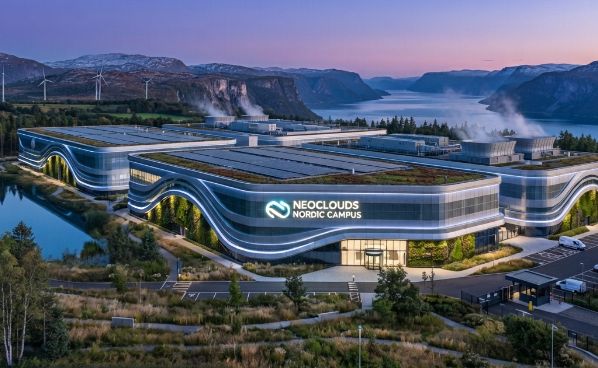
IMAGE: Artificially generated for illustration purposes only.
Get the latest commercial real estate news, investment insights, and property trends from Europe Real Estate, trusted by professionals since 1999.
Sign up for free weekly updates. Join here