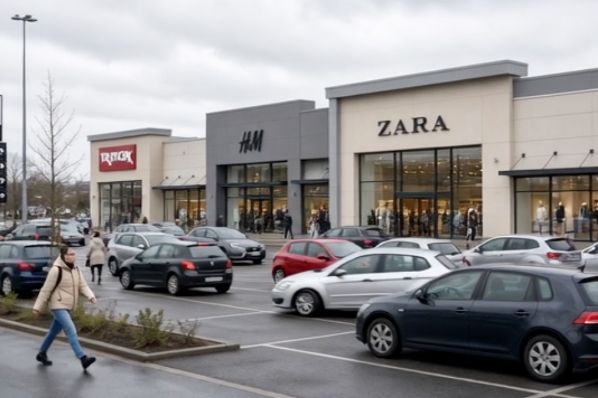
London, United Kingdom: Cross-border capital is playing a growing and increasingly decisive role in European retail park investment, with overseas buyers accounting for 52% of investment volumes in the first nine months of 2026, compared with approximately 41% on average over the preceding five years, according to new research from Savills. Investment in the asset class accelerated sharply in Q3 2026, reaching slightly more than €2bn, a 91% increase on the same period in 2025, as international capital continued to pivot towards a sector that has consistently outperformed broader commercial real estate benchmarks.
The geographic origin of that capital is shifting in ways that carry significant implications for the market. North America was the largest source of foreign investment, accounting for around half of cross-border volumes, while European investors contributed a smaller share than their long-term average. "The origins of capital are also changing. North America was the largest source of foreign investment, accounting for around half of cross-border volumes, while European investors contributed a smaller share than their long-term average. Middle Eastern and Israeli capital has become more prominent, representing around a fifth of overseas investment," said James Burke, Director, Global Cross Border Investment at Savills.
The performance data underpinning this capital flow is compelling. Retail parks and warehouses recorded a total return of 7.4% in 2025 according to MSCI, outperforming virtually every other mainstream commercial property sector in Europe. The average prime yield edged down from 5.73% in Q2 2026 to 5.72% in Q3, driven by compression in Stockholm, while yields held steady across all other European markets monitored by Savills. Retail warehousing was the only commercial property sector to record inward yield movements both quarter-on-quarter, at -1 basis point, and year-on-year, at -5 basis points, a rare combination that signals sustained and broadening investor conviction rather than a short-term repricing event.
The geographic composition of investment is also undergoing a structural rebalancing that deserves close attention. Core European markets still attract substantial capital, but their combined share of retail warehouse investment declined from 80% in 2021 to 48% during the first nine months of 2026. Over the same period, Central and Eastern Europe and Southern Europe increased their combined share from 14% to 46%. For developers and value-add investors, this structural rotation points to a maturing of the asset class beyond its traditional Western European heartland, and to a growing appetite for markets where yield premiums remain attractive and supply of institutional-grade retail park product is still limited.
"The investment case for European retail warehouses is increasingly centred on the resilience of income from value and convenience retailers. Price-conscious shoppers drive demand for space from these retailers, while relatively affordable occupation costs, compared with other retail segments, help them expand. For investors, this strengthens the appeal of operational assets with established tenants and scope to improve their performance," said Lydia Brissy, Director, European Research at Savills.
For investors and developers not yet active in this space, the convergence of factors is difficult to ignore. The retail park format offers what institutional capital is explicitly seeking in the current environment: inflation-linked income from defensive, non-discretionary retailers, lower capex requirements than enclosed malls, strong occupier demand from value and convenience operators expanding across both established and emerging European markets, and a yield premium over other retail formats that has not yet fully compressed. The growing role of Middle Eastern and North American capital, historically a leading indicator of sector maturity and liquidity depth, suggests the window for early-mover advantage in CEE and Southern Europe is narrowing.
Get the latest commercial real estate news, investment insights, and property trends from Europe Real Estate, trusted by professionals since 1999.
Sign up for free weekly updates. Join here
People
- James Burke, Director, Global Cross Border Investment, Savills
- Lydia Brissy, Director European Research, Savills
Companies
- Savills, global real estate advisor; publisher of the European retail park investment research cited in this article
- MSCI, global investment data and analytics provider; recorded 7.4% total return for retail warehousing in 2025, cited in the Savills research