Amsterdam – The IBC 2026 Innovation Awards, handed out at RAI Amsterdam, were framed as a celebration of broadcast and media breakthroughs. Read through a commercial real estate lens, though, they look more like a preview of the infrastructure that will define competitive advantage in hotels, offices, retail destinations and experiential venues over the next decade. The winners spanned open-source media workflows, live news distribution, broadcast-broadband convergence and AI-powered accessibility, and several have far more relevance to property owners than their broadcast framing suggests.
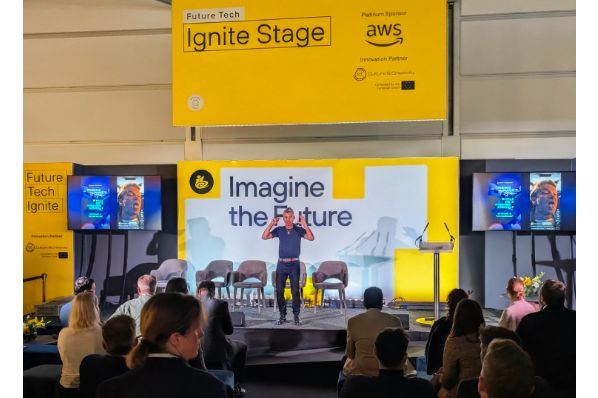
That framing was set early by Evan Shapiro, the industry's self-styled "Media Cartographer," whose Talent Programme keynote, "Mapping the Whole Consumer: From The Living Room to The WC," opened proceedings with new global data on video habits. His central argument, that reaching today's audiences means meeting them wherever they physically are, not just wherever they stream, is a thesis commercial real estate should take literally. If audiences are being mapped down to the room they are standing in, the physical spaces people actually occupy, lobbies, retail floors, waiting areas, transit hubs, become measurable, targetable media surfaces in their own right, not passive backdrops to a screen elsewhere.
The Social Impact award winner makes that shift tangible. G&L Systemhaus, working with AI company Signapse, software firm Norsk/id3as and CDN provider Akamai, built a broadcast-grade, AI-powered sign language solution for live and on-demand streaming. For hotel groups, retail destinations and mixed-use venues under growing regulatory pressure on accessibility, real-time AI translation is not a broadcast novelty, it is a compliance and guest-experience capability that could plausibly migrate into wayfinding, concierge services and live event signage within physical space. Globo's implementation of DTV+ in Brazil, which combined the reach of free-to-air television with the personalisation and measurability of digital media, points to the same convergence of broadcast and broadband that landlords are increasingly expected to embed into buildings.
The IBC Accelerator Project of the Year, AI Agent Assistants for Live Production, deserves particular attention from anyone thinking about experiential venues and stadiums. Backed by broadcasters ITN, the BBC and Channel 4, with participant vendors including Google Cloud, CUEZ, Amira Labs and Shure, the project demonstrated an AI Assistant Director orchestrating a suite of production agents through natural language, voice-controlled coordination of complex control room workflows. That same orchestration logic, multiple automated systems coordinated through a single AI layer, is precisely the direction smart building management is heading, and venues built to host live production today are being fitted, almost incidentally, with the operational backbone tomorrow's AI-managed buildings will need.
"Our 2026 IBC Innovation Awards winners share a common thread in breaking down previously insurmountable geographical, language, and organisational barriers to open media workflows. Each winner realises a transformational environment for collaborative, cloud-native, software-first digital ecosystems," said Fergal Ringrose, Chair of the Innovation Awards Jury. That "software-first" ecosystem thinking, open standards, cloud-native systems, cross-vendor interoperability, is the same principle increasingly shaping how forward-looking developers spec a building's digital backbone rather than treating connectivity as an afterthought bolted on after construction.
Elsewhere, Olympic Broadcasting Services received IBC's International Honour for Excellence for decades of innovation in ultra-high-definition production, immersive audio and remote production workflows, capabilities with an obvious afterlife in stadiums, arenas and large-scale mixed-use developments competing to host live events. CBC/Radio-Canada, alongside the European Broadcasting Union and the Linux Foundation, won the Content Creation category for deploying the open-source Media eXchange Layer, while Reuters was recognised in Content Distribution for a new event-driven news distribution architecture built with TVU Networks. Taken together with Shapiro's opening thesis, this year's winners point to the same underlying conclusion: the physical spaces best positioned to compete for attention and revenue will be the ones built with the connectivity, orchestration and data infrastructure this industry is already standardising around.
People mentioned:
- Evan Shapiro – Media Cartographer, ESHAP
- Fergal Ringrose – Chair, IBC Innovation Awards Jury
Companies mentioned:
- IBC – International media, entertainment and technology event organiser
- Akamai – CDN provider, Social Impact award winner
- Google Cloud – Participant vendor, IBC Accelerator Project of the Year
- Olympic Broadcasting Services – Recipient, International Honour for Excellence
- CBC/Radio-Canada – Content Creation award winner
- Reuters – Content Distribution award winner
Image Source: IBC - Evan Shapiro (Keynote)
Get the latest commercial real estate news, investment insights, and property trends from Europe Real Estate, trusted by professionals since 1999.
Sign up for free weekly updates. Join here